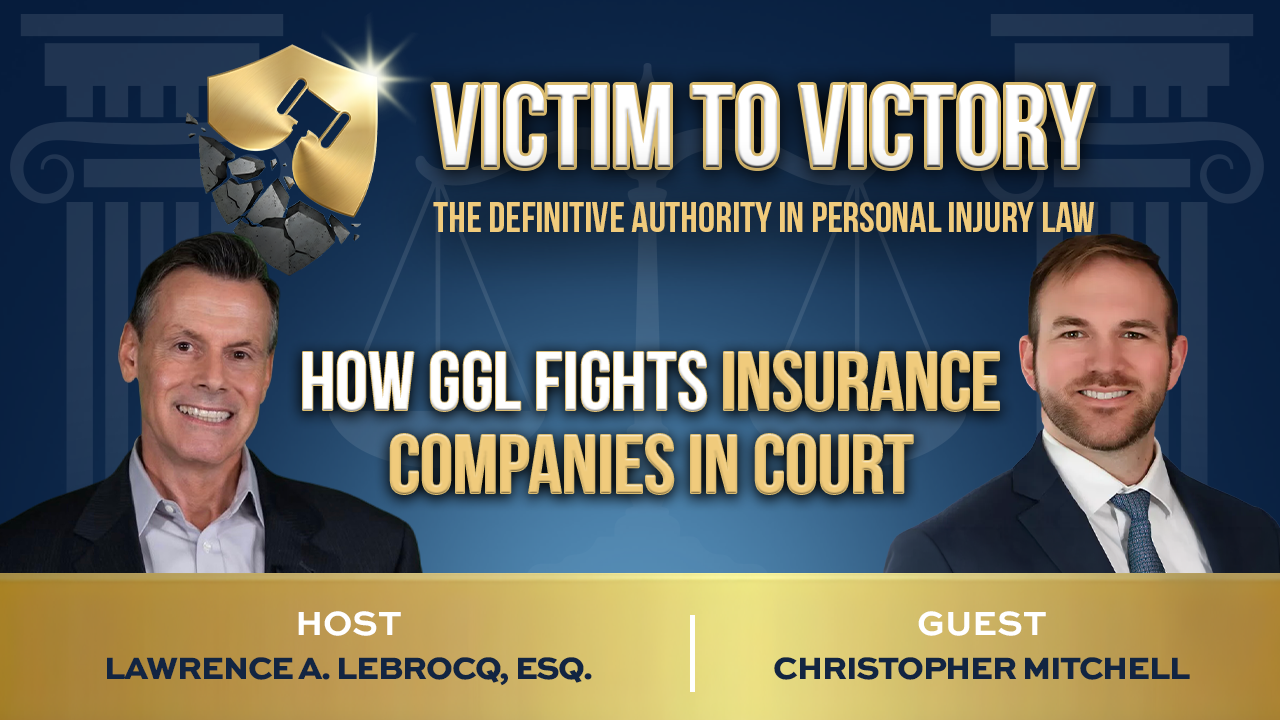
[00:00:00] Welcome and Introductions
Lawrence LeBrocq, managing partner of Garces, Grabler & LeBrocq, opens Victim to Victory and introduces Christopher Mitchell, a personal injury trial attorney at the firm. LeBrocq frames Mitchell as one of GGL’s top litigators. The segment sets the tone for a deep, practitioner-level conversation on trial preparation and client advocacy.
[00:00:50] Christopher Mitchell’s Path to Personal Injury Law
Mitchell explains that he did not grow up in a family of lawyers and had no predetermined path to the profession. His participation in mock trial in high school and college gave him his first exposure to plaintiff-side personal injury work, including a case involving toxic toy beads that poisoned a child. That experience cemented his direction.
[00:02:48] Why Plaintiff Work: Representing the People Without Power
Mitchell draws a clear line between defense-side and plaintiff-side personal injury practice. He explains his decision to represent injured individuals rather than insurance companies or corporations, describing clients as people who have never been through this, whose lives have been turned upside down, and who deserve an attorney willing to fight on equal footing with institutional defendants.
[00:03:49] First Major Trial at GGL: Jury Verdict Exceeds the Offer
Mitchell walks through one of his earliest cases at the firm, involving a passenger who sustained herniated discs and underwent a microdiscectomy. The insurance company’s offer failed to account for outstanding medical bills and the full extent of damages. GGL took the case to trial and the jury returned a verdict far in excess of what had been offered, establishing the standard Mitchell carries into every case.
[00:05:38] The Trial Preparation Philosophy in Practice
LeBrocq and Mitchell discuss why preparing every case for trial is non-negotiable at GGL. Mitchell explains that failing to prepare communicates directly to the insurance company that you will eventually accept a low offer, while full preparation signals the opposite. He adds that litigation has hard deadlines for discovery, and missing them can permanently eliminate a client’s ability to present critical evidence at trial.
[00:09:59] Mediation as a High-Pressure Settlement Tool
Mitchell explains when and why GGL uses mediation with retired judges as an alternative to trial, describing the process as a way to apply institutional pressure on insurance companies without absorbing the inherent risk of a jury verdict. He emphasizes that GGL approaches mediation from a position of full trial readiness, not desperation, and that a mediation can always be walked away from.
[00:10:21] The $2.75 Million Mediation Result
LeBrocq asks Mitchell about a major mediation that produced a $2.75 million resolution for a client who had sustained serious neck injuries. Mitchell confirms the result and explains that the scale of the damages in the case made mediation the right venue to achieve full value while managing trial risk.
[00:11:57] Balancing Aggression with Client Empathy
LeBrocq raises the tension between aggressive litigation and genuine compassion for injured clients. Mitchell describes the two distinct roles a plaintiff’s attorney plays: the counselor, who listens and understands what a client has truly been through in order to understand and communicate the full scope of damages, and the advocate, who communicates to opposing counsel without hesitation that the case will go to trial if necessary.
[00:14:18] PIP No-Fault Coverage: What It Pays and Where It Fails
Mitchell explains New Jersey’s personal injury protection system, describing it as no-fault coverage that pays for medical treatment up to policy limits. He notes that the minimum policy of $15,000 can be exhausted after a single hospital visit, leaving clients exposed to significant outstanding medical bills that must then be pursued as damages from the at-fault party. LeBrocq advises upgrading to the $250,000 standard policy.
[00:16:21] Negligence: What Plaintiff’s Attorneys Must Prove
Mitchell defines negligence and explains how it applies across motor vehicle accidents, trip and fall cases, and other personal injury contexts. He walks through the elements: a duty, a breach, causation, and resulting injury. He distinguishes negligence from intentional conduct to clarify why personal injury cases hinge on the wrongful conduct of another party rather than deliberate intent.
[00:18:13] Strict Liability and New Jersey Dog Bite Law
LeBrocq raises strict liability, specifically in the context of dog bites. Mitchell explains that under New Jersey’s strict liability statute, a dog owner is automatically responsible for injuries caused by a bite regardless of whether the dog had ever bitten anyone before. No proof of a vicious propensity is required. LeBrocq shares a recent case in which a client suffered extreme facial injuries from a dog attack.
[00:19:18] Understanding Damages: Pain and Suffering, Lost Wages, and Future Costs
Mitchell breaks down the full spectrum of damages in a personal injury case, including non-economic damages such as pain, numbness, limitations on daily activities, and quality of life changes, as well as economic damages including outstanding medical bills and lost wages. LeBrocq adds that significant injury cases can also include future lost wages supported by an economist’s testimony and life care plans to account for anticipated future medical treatment.
[00:22:18] What to Do Immediately After an Accident
Mitchell lays out the practical steps every injured person should take after an accident: seek medical treatment immediately, take photographs of injuries and vehicle damage before they heal or are repaired, and contact a qualified personal injury attorney as early as possible. He stresses that cases can take four or more years to resolve, and evidence not preserved in the immediate aftermath may be unrecoverable by the time the case reaches trial.
[00:24:35] Why Insurance Companies Track Which Firms Go to Trial
LeBrocq asks whether insurance companies actually track individual firms by their willingness to litigate. Mitchell confirms it directly: these are multi-billion dollar corporations with every incentive to know which firms will accept low offers and which will not. Firms that do not prepare for trial are identified and systematically under-offered. GGL’s reputation as a firm that goes to trial is itself a form of leverage.
[00:25:35] Advice for Aspiring Trial Litigators
Mitchell addresses law students and future litigators directly, recommending mock trial experience above almost everything else as the most practical preparation for a career in plaintiff’s personal injury work. He also recommends real world experience through internships and law firm positions focused on personal injury. LeBrocq adds his own list of the five most practical law school courses, including mock trial, moot court, rules of evidence, rules of civil procedure, and counseling and negotiations.
[00:27:30] How to Reach Christopher Mitchell at GGL
Mitchell explains how prospective clients can reach him through Garces, Grabler & LeBrocq’s intake team. He describes the process from initial call through attorney meeting, covering what the firm needs to know, what rights will be explained, and how GGL ensures every client is on the path toward maximum compensation from the first contact.