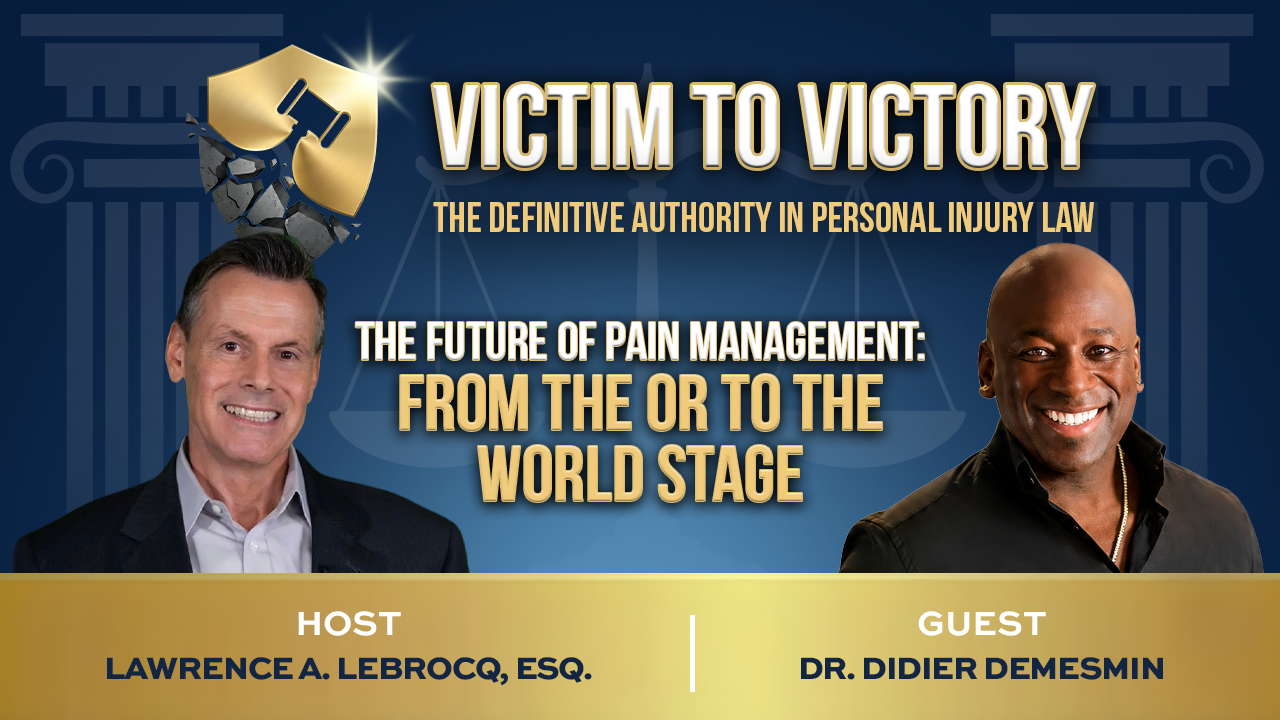
[0:00] Welcome & Introduction
Lawrence LeBrocq opens the show and introduces Dr. Didier Demesmin, board-certified pain management specialist, recognized globally as the #1 pain management doctor in the world, with practices across New Jersey and New York.
[0:59] Minimally Invasive Spine Surgery: The New Standard
Dr. Demesmin explains how minimally invasive techniques have completely transformed spinal care. Using a car analogy, he describes how surgeons can now “look under the hood” without major disruption, reducing recovery from 6+ months down to days and weeks.
[2:28] Open Surgery vs. Minimally Invasive: What’s the Difference?
A clear breakdown of why the old open-surgery model is being replaced. Dr. Demesmin explains that smaller incisions mean less muscle damage, lower infection risk, and a faster return to normal life, and that surgeons can always scale up if needed, but never go smaller after the fact.
[5:45] Training the Next Generation: St. Peter’s University Hospital
Dr. Demesmin discusses his faculty role and how he teaches minimally invasive surgical techniques to the next generation of surgeons. He explains the difference between approaching spinal issues caused by aging versus trauma, and why that distinction changes the entire treatment plan.
[7:43] Lecturing Across the Globe
Dr. Demesmin shares his international lecturing schedule: Vietnam, Korea, San Francisco, Croatia, London, and Brazil and why staying at the cutting edge requires learning from the world’s greatest surgeons, not just teaching them.
[7:58] What Is a Rhizotomy? Breaking It Down
Lawrence asks Dr. Demesmin to explain the rhizotomy procedure for lay audiences. Dr. Demesmin walks through how burning the nerve that transmits pain signals provides long-lasting relief, and how it’s now done in under an hour with patients going home the same day.
[9:09] From San Francisco to Croatia to Brazil: The Global Circuit
A deeper look at the international conferences and surgical training programs Dr. Demesmin participates in, including WCMIST and other world-class venues. He emphasizes how staying global keeps his techniques ahead of the curve for his New Jersey/New York patients.
[10:46] Regenerative Medicine & Orthobiologics: The Future Is Here
Dr. Demesmin breaks down PRP (platelet-rich plasma), stem cell therapies, and orthobiologics, explaining how the body’s own healing mechanisms are being harnessed to repair tissue without surgery. He describes it as one of the most exciting frontiers in modern medicine.
[12:24] Running a Practice While Traveling the World
Lawrence asks the question every patient wonders: does Dr. Demesmin actually have time to see patients? The answer, yes. He explains his highly trained PA team, two additional in-practice physicians, and his personal commitment to always being available to his patient base.
[13:25] Learning at the World’s Top Surgical Conferences
Why attending and lecturing at elite conferences like WCMIST makes Dr. Demesmin a better doctor for his patients and how exposure to the world’s top techniques directly translates into better outcomes back home.
[14:47] The Evolving Field: AI Meets Pain Management
Dr. Demesmin draws a striking parallel between AI in technology and minimally invasive advances in medicine. Both are evolving at a pace that was unthinkable a decade ago. Being recognized as the #1 pain management doctor in the world, he says, reflects that commitment to staying on the absolute leading edge.
[16:00] How to Find Dr. Demesmin
Practices are located across New Jersey and New York. Dr. Demesmin emphasizes that patients don’t need to travel to Cambodia or Korea, world-class minimally invasive pain management is right in their backyard.
[17:01] What Exactly IS a Pain Management Doctor?
Lawrence asks for a clear explanation for patients who may not know the difference between a pain management doctor, orthopedic surgeon, neurosurgeon, or neurologist. Dr. Demesmin explains that pain management is a fellowship-trained subspecialty that evolved from anesthesia, bridging the gap between diagnosis and surgery.
[17:27] Interventional Pain Management: Beyond Pills
Dr. Demesmin explains how modern pain management moved away from opioids and toward interventional procedures like injections, nerve blocks, ablations. And how AI is now being integrated into surgical planning to improve precision and outcomes.
[18:36] AI in Surgical Procedures: The Next Frontier
A fascinating segment on how AI is being incorporated into real-time surgical decision-making, analyzing intraoperative nuances that the human eye might miss, allowing surgeons to refine their technique mid-procedure with data-driven guidance.
[19:22] The Exciting Future of the Field
Dr. Demesmin reflects on why it’s an extraordinary time to be in pain management, and why patients today have access to options that simply didn’t exist five years ago.
[19:55] Spinal Cord Stimulators: The Pacemaker for Pain
Lawrence asks about spinal cord stimulators for chronic pain. Dr. Demesmin explains how these implantable devices work like a pacemaker, sending electrical impulses to the spinal cord to interrupt pain signals, and how they’ve evolved to become smaller, smarter, and more effective.
[20:48] Brain Stimulators, Cingulotomies & ECT: Pain at the Source
A remarkable segment on cutting-edge brain-based pain interventions, including deep brain stimulation and cingulotomies that target the emotional perception of pain at its neurological origin, without the side effects of electroconvulsive therapy.
[21:45] The Full Arsenal: Implantable Devices Changing Lives
Dr. Demesmin lists the full landscape of implantable pain technologies now available, cord stimulators, peripheral nerve stimulators, and emerging devices, and why the field has never offered more tools to eliminate suffering.
[22:10] New Cage Technology & Disc Replacements
Lawrence and Dr. Demesmin discuss the latest in spinal hardware, including tiny cages for fusion surgery and next-generation disc replacements that attach directly to upper and lower vertebrae without a cage, dramatically reducing invasiveness.
[23:07] Advancements in Orthobiologics & Getting Patients Active
The final clinical segment covers how orthobiologics are helping patients reclaim their quality of life, getting back to sports, picking up their kids, and living without the limitations that chronic pain once imposed.
[24:28] Outro & How to Reach Dr. Demesmin
Lawrence closes out the episode with praise for Dr. Demesmin’s contributions and encourages listeners to reach out through his New Jersey and New York practices.