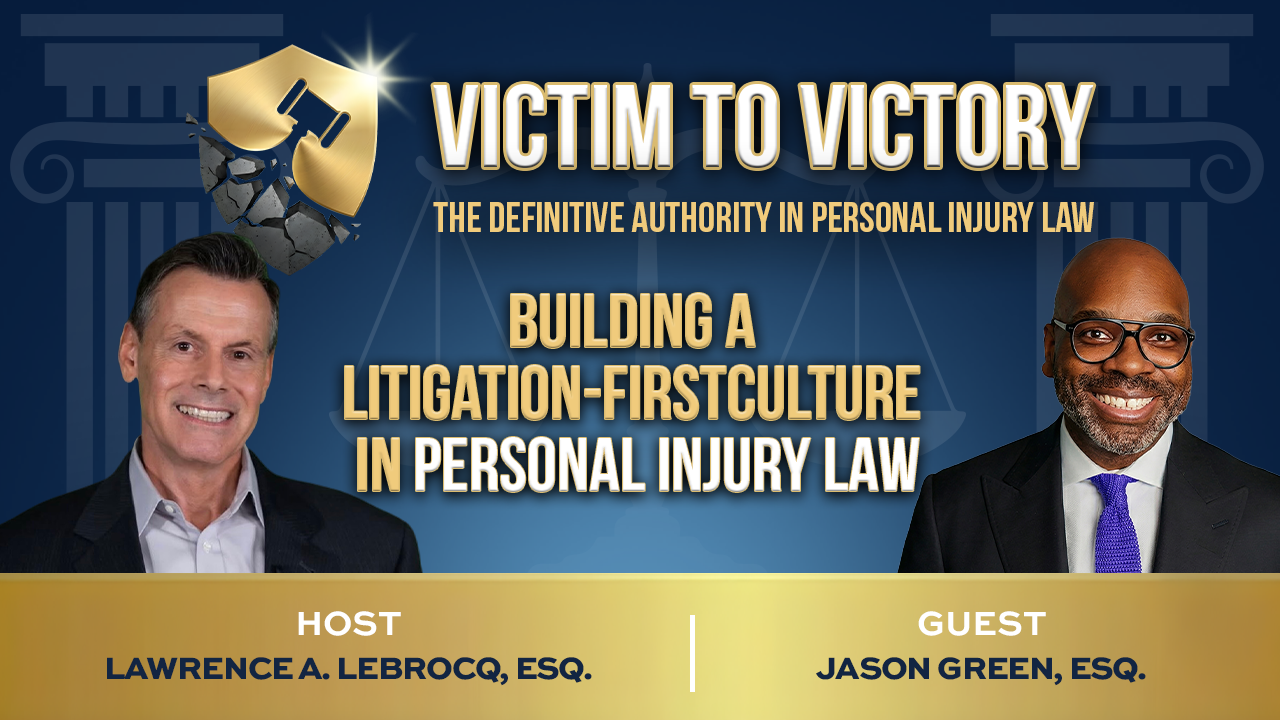
[00:00:00] Welcome and Introductions:
Lawrence LeBrocq, CEO and Managing Partner of Garces, Grabler & LeBrocq, welcomes Jason Green, Managing Attorney at Bader Law in Atlanta, Georgia. Both hosts share parallel careers that moved from heavy trial litigation into firm leadership roles, and Lawrence frames the episode around the shared philosophy that every case must be prepared for trial from day one.
[00:01:03] Jason Green’s Prosecution Background and What It Taught Him About Storytelling:
Jason recounts his years as a top prosecutor in Georgia handling rape, sexual assault, and death penalty cases where the stakes were life sentences or decades behind bars. He explains that those high-stakes environments taught him the lesson that drives his entire practice: facts alone do not win; you must build a compelling, emotionally resonant story that moves a jury beyond pure logic and intellect.
[00:03:30] The Trial First Philosophy: Building the File from Day One:
Jason walks through why preparing every case as if it will go to a jury is not just a philosophy but a strategic weapon. Evidence erodes, memories fade, and witnesses become harder to locate as time passes. More importantly, when opposing counsel and adjusters see an attorney who arrived at a deposition with experts already engaged and incisive questions already mapped out, the settlement offers escalate quickly, and the defense starts chasing the plaintiff to close the case.
[00:08:27] What Trial Preparation Actually Uncovers That Documents Never Will:
Jason explains that medical charts, interrogatories, and RPDs from the other side will never build your case for you. Only by sitting down with the injured client, their family members, friends, neighbors, and coworkers do lawyers discover the details and context that transform a routine case into a compelling human story with expert testimony, objective facts, and emotional truth woven together.
[00:09:21] The Before and After Witness: Humanizing the Client for the Jury:
Lawrence introduces the term he uses internally at GGL, and Jason confirms Bader Law uses the same language. The before-and-after witness, a person who knew the client intimately before the injury and can describe what was lost, is the most persuasive evidence a plaintiff lawyer can control. Jason notes that clients themselves often no longer recognize how much their life has changed because adapting to a new norm becomes invisible over time, which means the legal team must probe intentionally and listen for small details that open larger doors.
[00:12:41] Why Before and After Witnesses Are Nearly Immune to Cross Examination:
Lawrence makes the tactical point that the defense bar has almost no effective cross-examination available for a before and after witness beyond asking whether the witness likes the plaintiff and wants them to succeed. Because these witnesses speak about another person rather than themselves and about lived observable changes rather than legal conclusions, they land with juries in a way that experts and medical records alone cannot replicate.
[00:12:49] The Transition from Litigator to Managing Attorney:
Both Lawrence and Jason discuss the unexpected path from trying cases constantly to running a firm. Jason describes being recruited by Seth Bader specifically to transform Bader Law into a litigation-first organization with trial, not pre-litigation settlement, as the firm’s defining emphasis. He describes the appeal as the challenge of changing the trajectory of an entire firm and building a team of what he calls disciples of the litigation-first mindset.
[00:15:22] Overcoming Attorney Fear of Trial and Managing the Litigation Team:
Jason addresses the fear factor that surfaced among attorneys he had not previously worked with, acknowledging that public speaking is statistically one of the top phobias in the general population and that lawyers are not immune. He reframes losing at trial not as failure but as a rite of passage, drawing on his own obsession with analyzing losses the way elite athletes study their worst performances. His standard for his team is not whether they win but whether they were prepared and whether they went hard for the client.
[00:19:48] What the Defense Side Fears: The Psychology of Insurance Companies at Trial
Drawing on direct experience working defense, Jason explains that insurance companies are built around calculating and eliminating uncertainty, and that trial is uncertainty by definition. A plaintiff lawyer who is known to be skilled, tenacious, relatable to juries, and willing to actually go to trial strikes a fear in defense coworkers and adjusters that goes well beyond the fear felt by the plaintiff’s own attorney. That fear is what ultimately drives premium settlement offers.
[00:22:55] How Plaintiff Reputation Changes the Math: The Colossus Story
Lawrence shares a story from his own career in which a defense lawyer disclosed that their risk software had calculated Lawrence’s personal probability of winning a weak case at 37.5 percent versus the 5 percent average for other attorneys on the same facts and offered accordingly. Jason connects this directly to the power of consistent trial preparation and the compounding reputation it creates over time.
[00:23:47] Opening Statement as the Most Important Moment at Trial
Jason describes an evolution in his own philosophy: early in his career he lived for closing argument, but he has come to believe that a commanding opening statement, where the plaintiff’s lawyer controls the narrative, orders the witnesses and evidence, and puts the defense permanently on their heels before they speak, is where cases are actually decided. He describes the feeling of finishing an effective opening as knowing there is no way back for the other side.
[00:26:19] The Barbershop Test: Workshopping Themes with Everyday People
Jason reveals his practice of pressure testing case themes, complex medical concepts, and emotional narratives with his wife, family, cookout guests, and anyone outside the legal bubble who represents the kind of regular citizen who will sit on a jury. The goal is to distill technical points down to the language a five-year-old could follow, a standard he attributes to Denzel Washington’s character in Philadelphia, because juries are comprised of people who work at the Applebee’s and deliver your mail.
[00:28:19] Three Pieces of Advice for Young Trial Lawyers
Jason closes with three direct recommendations: first, lose the fear because every lawyer including the legends had a first and second trial; second, prepare for every contingency because preparation gets you through the process and eases nerves; and third, be your unique authentic self because juries are powerful truth machines and they can detect inauthenticity immediately. He warns against wholesale copying another lawyer’s style and tells his team to find their own story and tell it in their own voice.
[00:31:14] Where to Find Jason Green and Bader Law
Jason invites anyone seeking representation or looking to connect to reach him directly at jasongreene@baderlaw.com or through baderlaw.com. Lawrence closes by noting the ongoing mastermind relationship between Garces, Grabler & LeBrocq and Bader Law and teases continued collaboration on trial strategy.