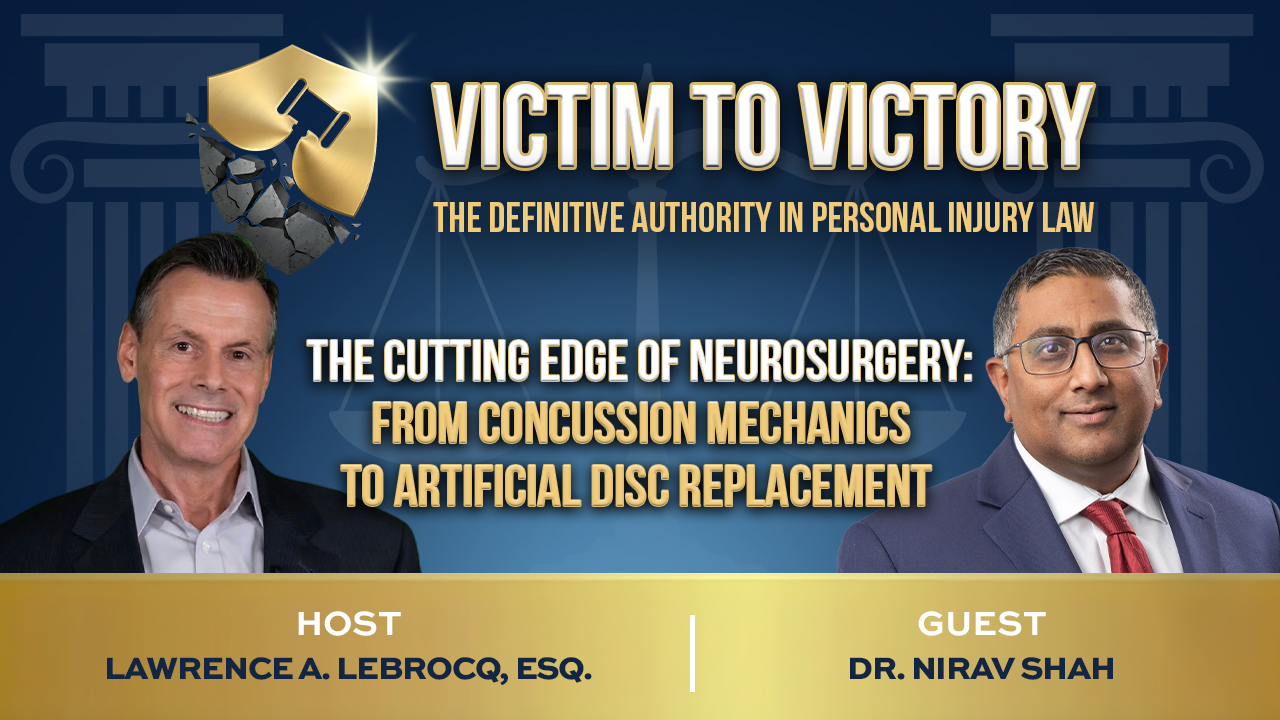
[00:00:56] Meet Dr. Nirav Shah
New Jersey personal injury lawyer Lawrence LeBrocq introduces Dr. Shah, a board-certified neurosurgeon with Princeton Brain, Spine and Orthopedics, serving as a top authority in both brain and spine surgery.
[00:05:31] Debunking Brain Injury Myths
Dr. Shah explains why the “no impact, no injury” defense is scientifically inaccurate. He describes how acceleration and deceleration forces cause the brain to “accordion” against the skull.
[00:07:56] The Gold Standard: DTI Scans
Moving beyond basic CAT scans, Dr. Shah discusses Diffuse Tensor Imaging (DTI). This advanced study tracks water molecules to identify “diffuse axonal injury” that remains invisible on traditional imaging.
[00:10:40] Why the Spine is a “Pogo Stick”
A look at why the neck (cervical) and low back (lumbar) are the most common trauma sites. Unlike the rib-protected mid-back, these mobile segments absorb the brunt of collision forces.
[00:14:45] Proving Acute Injury over Degeneration
Dr. Shah describes his “detective” approach to clinical correlation, using history, physical exams, and “bright signals” (hydration/swelling) on MRIs to prove an injury is new rather than age-related.
[00:20:33] Artificial Disc Replacement vs. Fusion
A comparison of surgical options. Dr. Shah explains the newer “ball and socket” synthetic devices designed to replicate natural spinal motion and “kick the can down the road” to avoid traditional fusions.
[00:23:02] Cauda Equina: The Horse’s Tail
A critical warning on Cauda Equina Syndrome. Dr. Shah outlines the symptoms—including bowel or bladder dysfunction—that require emergent surgery to prevent permanent, unforgiving nerve damage.