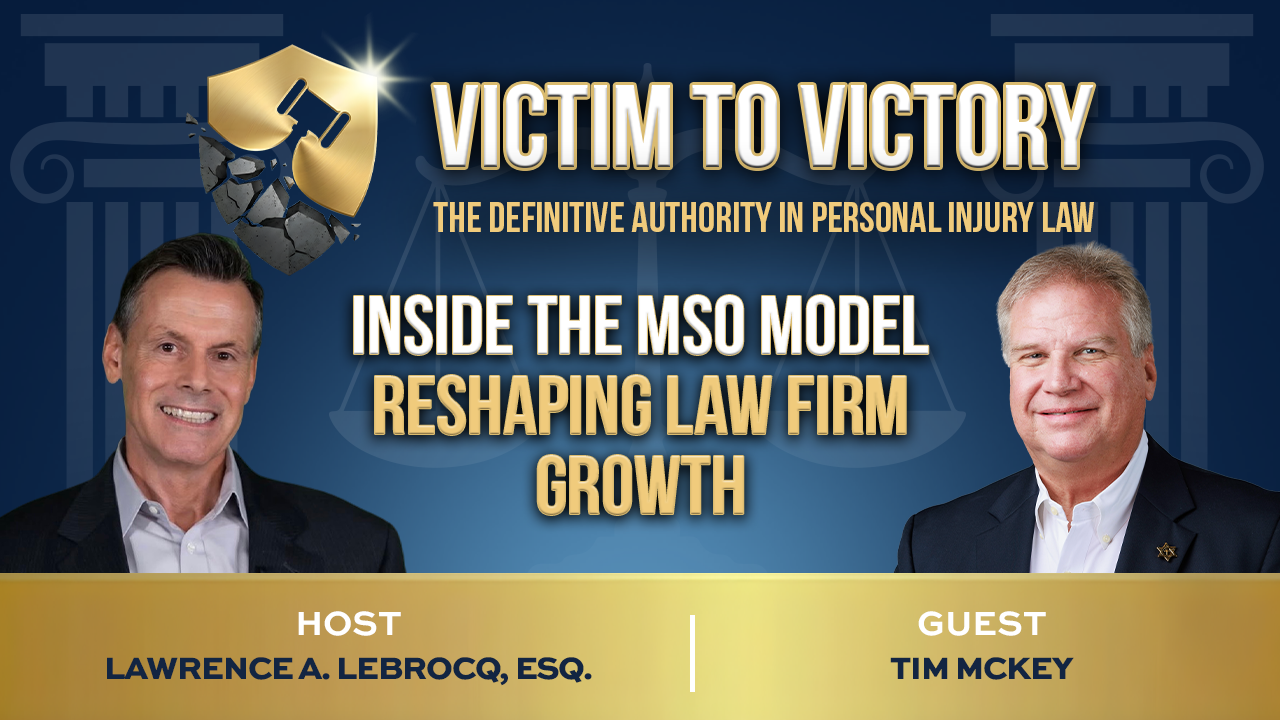
[00:00:00] Welcome and Introductions
Lawrence LeBrocq, Managing Partner of Garces, Grabler & LeBrocq and host of Victim to Victory, welcomes Tim Mckey, owner of Vista Consulting, a national law firm consulting group. Lawrence introduces Tim as a recognized authority in law firm operational leadership who built his reputation entirely through word of mouth. The episode sets up a deep dive into systems, structure, and the metrics that separate high performing personal injury firms from the rest.
[00:00:45] From Deloitte to Consulting: Tim Mckey’s Origin Story
Tim walks through his career arc from Deloitte in the mid 1980s through a partnership in a CPA firm at age 27 to an inflection point around 1998 and 1999 when hourly billing no longer made sense to him. He realized he was more energized by advising business owners on operations than by keeping score through tax work. That realization led him to convert his CPA practice into a consultancy.
[00:04:01] How Vista Consulting Was Born Inside a Personal Injury Firm
Tim describes how Vista’s identity crystallized when an early client, a personal injury plaintiff firm, showed them exactly what operational chaos looks like. The firm was spending heavily on marketing but had no intake training, no structured handoff to case managers, and no logic around case sizing. Vista built the systems, hired Chad Dudley as COO for that firm, and the consulting business expanded from there.
[00:06:24] What Vista Looks for in a Law Firm
When a managing partner calls saying something is not working, Vista starts with a full operational review, stem to stern. Tim explains that profit is a result, not a target. It follows good systems, effective client service, and measurable processes. The firm evaluates operational metrics including lead volume, lead qualification rate, and sign up rate.
[00:10:03] Common Operational Bottlenecks in Personal Injury Firms
Tim identifies a recurring failure point: pre-litigation staff who resist handing cases to litigation when the facts warrant it, because their incentives point the wrong way. He also names the trap of having lawyers answer intake calls while simultaneously managing active litigation, a structural problem that dilutes both functions.
[00:11:52] ABS vs. MSO: The Structures Reshaping Law Firm Ownership
Tim defines both models clearly. The alternative business structure, pioneered in Arizona, allows non-lawyers to own a law firm outright but carries cross-state ethical complications. The management services organization is a separate entity that owns all non-legal functions, from marketing to staffing to brand licensing, and contracts those services back to the law firm. That separation allows non-lawyer ownership of the MSO without touching the practice of law.
[00:15:03] Why the MSO Model Is Winning and the ABS May Be Fading
Tim gives his direct assessment: the MSO structure is more ethically sound, more operationally clean, and more attractive to private equity. He cites Trish Rich of Holland & Knight, an expert in the space, who frames the only two MSO failure modes as setting it up wrong or running it wrong. Legacy planning, non-lawyer equity rewards, and investor access are all cleaner under the MSO model.
[00:20:06] The Two KPIs That Drive Everything
Tim frames law firm growth around exactly two levers: getting more cases and increasing resolution value. He maps the KPIs to each lever, with intake statistics controlling volume and client contact frequency controlling case value. He argues these two metrics are the ones most often left untracked, and that without tracking them, accountability is impossible.
[00:21:56] Accountability Systems and the 21 Day Contact Rule
Tim and Lawrence discuss how to hold team members to performance standards without micromanaging. The answer is a case management system configured to track contact intervals, produce reports by paralegal, and give every team member visibility into their own numbers. Vista recommends client contact at minimum every 21 days, recorded and reportable.
[00:26:41] The Marketing Blind Spot: Past Clients and the Referral Engine
Tim identifies the most overlooked growth lever in personal injury: the existing client base. Firms spend heavily on billboards and television while failing to send a newsletter, a birthday card, or a settlement anniversary note to people who have already trusted them. He states plainly that across more than 300 firms, the largest cases consistently come from referrals by former clients.
[00:29:16] How to Reach Vista Consulting
Tim directs listeners to vistact.com, the Vista Consulting website, where his full contact information is available. He summarizes the firm’s mission in one line: “We help our clients help theirs.”